Slow Down and Listen: Why Vinyl's Built-In Friction Makes You a Better Audience
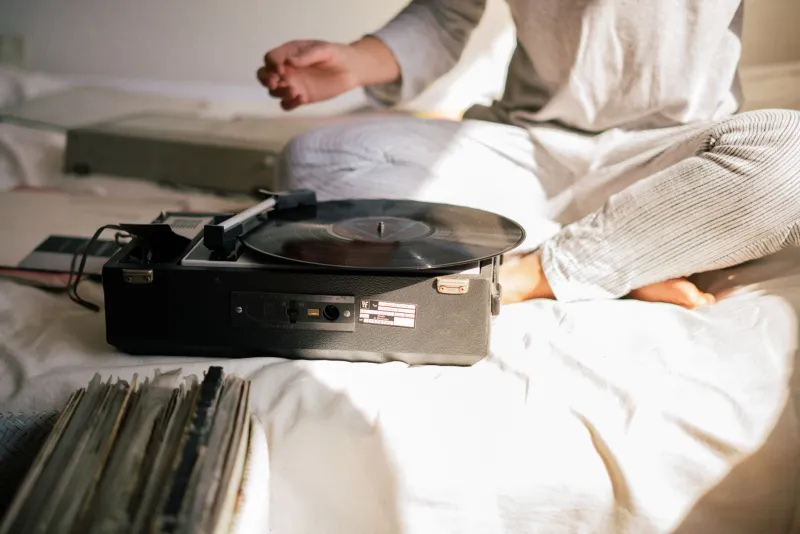
There's a moment every vinyl listener knows. The record is on the platter. The arm swings out. The needle finds the groove. And for a second — maybe two — there's nothing but the faint crackle of anticipation before the music begins. It's a pause that streaming will never replicate, and it turns out that pause might be doing more for your brain than any algorithm-generated playlist ever could.
We live in a culture that treats friction as a problem to be engineered away. Skip buttons, autoplay, infinite scroll — every digital innovation is designed to eliminate the gap between wanting something and having it. But a growing number of researchers, music therapists, and collectors are making a compelling case that friction isn't the enemy of a good listening experience. Sometimes, it's the whole point.
The Ritual Isn't Just Ceremony
Ask any serious collector why they still spin wax in an era of lossless streaming, and the word ritual comes up fast. Pulling the record from its sleeve, checking the surface for dust, setting the weight on the tonearm — these aren't obstacles. They're preparation. They shift your mental state before the first note even plays.
Dr. Psyche Loui, a neuroscientist at Northeastern University who studies music and the brain, has described the way anticipatory rituals prime the brain's reward circuitry. When you perform a consistent sequence of actions before a pleasurable experience, you're essentially telling your nervous system something meaningful is about to happen. Your attention sharpens. Your emotional receptors open up. By the time music actually starts, you're not passively consuming — you're actively receiving.
Streaming skips that priming entirely. You tap a song, it plays, and your brain never got the memo that this was supposed to matter.
Side A Ends. Now What?
Here's the part that streaming really can't fake: the side flip.
Vinyl forces a physical interruption at roughly the halfway point of an album. You have to get up, cross the room, lift the needle, flip the record, and start again. For people raised on shuffle culture, this sounds like an inconvenience. For collectors, it's often described as one of the most underrated features of the format.
Music therapist and board-certified clinician Dr. Sherry Walling, who has written about music's role in emotional processing, has noted that intentional pauses during emotional experiences allow the mind to consolidate what it's absorbed. Think of it as a natural intermission — a moment to breathe, reflect, and re-engage. Albums that were sequenced for vinyl often exploit this structure deliberately. The Beatles didn't just fill two sides with songs; they built emotional arcs with that break in mind. So did Joni Mitchell, Marvin Gaye, and Bruce Springsteen. The flip wasn't an inconvenience — it was a compositional tool.
When you stream Rumours or What's Going On front to back without interruption, you're technically hearing every note. But you might be missing the architecture.
You Can't Skip Your Way Out of Discomfort
One of the more psychologically interesting aspects of vinyl listening is what it demands of you when a song isn't immediately gratifying. On a streaming platform, a track that doesn't hook you in the first thirty seconds gets skipped. It's a reflex, practically involuntary at this point. But on vinyl, skipping is a production. You have to physically move the needle, risk a scratch, disrupt the whole experience. Most listeners just... let it play.
And something funny happens when you let it play. Songs that seemed slow or strange on first pass reveal themselves over time. The weird bridge you almost skipped becomes your favorite part. The quiet track you would have swiped past turns out to be the emotional center of the whole record.
Collectors talk about this constantly — the album that didn't click until the third or fourth spin, the deep cut that snuck up on them because they had no choice but to sit with it. That's not nostalgia talking. That's patience producing results.
Research on what psychologists call mere exposure effect supports this. Repeated exposure to a stimulus — even one that initially seems neutral or unappealing — tends to increase positive feelings toward it. Vinyl's resistance to skipping essentially forces the mere exposure effect on its listeners, whether they realize it or not.
The Drift State
There's a particular quality of attention that vinyl seems to encourage — not quite active, not quite passive, but somewhere in between. Collectors sometimes describe it as a kind of drift: you're present, you're listening, but you've also let go of whatever else was competing for your attention. The record demands just enough engagement to hold you there without demanding so much that it becomes work.
This state has a psychological name: flow, as defined by psychologist Mihaly Csikszentmihalyi. It's the condition of being fully absorbed in an activity that's neither too easy nor too challenging. The ritual of vinyl listening — its tactile demands, its pacing, its built-in pauses — seems almost tailor-made to produce it.
Streaming, by contrast, is designed for multitasking. It's background music, workout music, commute music. That's genuinely useful. But it rarely produces the drift state, because it asks almost nothing of you. When an experience demands nothing, your brain treats it accordingly.
What Collectors Already Know
None of this is news to anyone who's been digging crates for years. The vinyl faithful have been describing these experiences in their own language long before neuroscience gave them clinical vocabulary. They talk about albums they know deeply — not just the hits, but the transitions, the fades, the silences between tracks. They talk about sitting with a record and letting it change their mood rather than selecting a mood and finding a record to match it.
That's a subtle but meaningful distinction. Streaming is reactive. Vinyl is transformative.
At The Drift, we've always believed that the best listening happens when you give a record room to breathe. That's not a romantic notion — it's increasingly well-supported by the science of attention and emotional memory. The friction in vinyl isn't a design flaw left over from an earlier era. It's a feature that the format's inventors may not have fully understood, but that listeners have been benefiting from for decades.
Making Time for the Slow Listen
You don't have to abandon your streaming service to get some of this back. But if you own a turntable — even a modest one — consider making space for what collectors call the intentional listen. Put a record on. Sit down. Don't check your phone. Let Side A play all the way through, get up for the flip, and let Side B finish before you do anything else.
It might feel strange at first. A little slow. Maybe even boring for the first few minutes. That's the friction doing its job — clearing out the noise so the music can actually land.
Give it time. The drift is worth it.