Lost in the Bins: Why Stumbling Through a Record Store Still Beats Any Algorithm
There's a particular kind of music discovery that only happens when you're not looking for anything specific — when a sleeve catches your eye, a track listing intrigues you, and suddenly you're forty minutes deep into an artist you'd never heard of an hour ago. Streaming platforms have spent billions trying to replicate that feeling. They haven't come close.
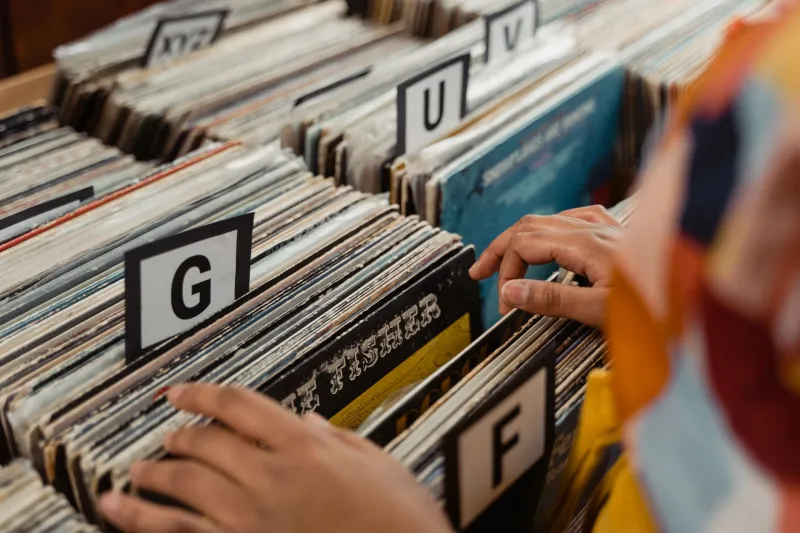
Walk into any independent record shop on a Saturday afternoon and you'll see it playing out in real time. Someone flips past a record they recognize, stops on one they don't, pulls it out, reads the liner notes, checks the label, puts it back — then picks it up again thirty seconds later. That hesitation, that second look, that moment of maybe — that's where real music discovery lives. No recommendation engine has ever built anything that feels remotely like it.
The Algorithm Knows What You Already Like
Here's the fundamental problem with algorithmic curation: it's designed to keep you comfortable. Every playlist, every "you might also like" suggestion, every autoplay queue is built on what you've already listened to, what you've already approved of, what you've already signaled you enjoy. The system is optimizing for engagement, not growth. It wants you to stay on the platform, not to be challenged by it.
That's a subtle but serious distinction. When Spotify drops a Discover Weekly playlist in your lap, it's not trying to expand your musical worldview — it's trying to hold your attention for another thirty minutes. The difference between those two goals might seem small, but over months and years, it compounds. You end up in a musical echo chamber that's been carefully constructed around the version of yourself that existed when you first signed up.
Vinyl crates don't work that way. Vinyl crates have no idea who you are.
The Beautiful Chaos of Physical Browsing
When you're flipping through a bin of used records, the organizational logic — if there is any — belongs to whoever sorted them last. You might be working through a section loosely labeled "Soul" and suddenly find yourself holding a Brazilian bossa nova record filed by someone who apparently thought it was close enough. You might pull out a jazz record because the cover art looked interesting, flip it over, and discover the bassist played on three albums you already love. You might buy something entirely on the strength of a name you half-remember from a documentary you saw once.
None of that is efficient. All of it is genuinely educational.
The tactile process of physical browsing forces a kind of lateral thinking that streaming interfaces actively discourage. You're not clicking through a grid of pre-approved suggestions — you're navigating a physical, slightly chaotic archive that rewards curiosity and punishes tunnel vision. The collector who only looks for what they came in for almost always leaves with less than the one who lets the bins take them somewhere unexpected.
There's a reason so many serious collectors talk about their best finds as accidents. That's not modesty. That's just how it works.
Serendipity as a Music Education
Think about how the most musically knowledgeable people you know actually got that way. Almost none of them learned through a structured, algorithmic path. They learned through contamination — a friend played them something weird, a record store clerk made an offhand recommendation, they grabbed something off the wrong shelf and it turned out to be extraordinary. Music knowledge spreads through accidents and tangents, not through curated playlists.
The physical record store has always been one of the best environments for that kind of contamination to happen. You're browsing near someone who clearly knows what they're doing, and you watch what they pull out. You overhear a conversation between a customer and a clerk about a pressing you didn't know existed. You pick up a compilation because it has one artist you recognize and discover four others you've never encountered. The whole experience is porous in a way that a streaming interface, with its clean categories and confident recommendations, fundamentally isn't.
This is the thing that doesn't translate to a screen: the record store is a social and spatial environment, not just a catalog. The knowledge embedded in those bins comes from dozens of people — the previous owners who bought and sold these records, the staff who sorted them, the collectors who passed through before you. When you flip through a crate, you're engaging with all of that accumulated taste and history in a way that feels genuinely irreplaceable.
What Gets Lost When Discovery Goes Digital
One of the quieter casualties of the streaming era is the concept of musical adjacency — the idea that understanding one artist or genre requires understanding what surrounds it. Jazz collectors know this instinctively. You can't really understand Miles Davis without understanding the musicians he played with, the labels he recorded for, the era he was working in, the genres he was borrowing from and reacting against. That web of context is something you absorb slowly, over years, through physical exploration.
Algorithms flatten adjacency into similarity. They'll tell you that if you like Miles Davis, you might like John Coltrane — which is true, but also kind of misses the point. The more interesting discovery is the one that's adjacent without being similar: the Afrobeat record that shares a rhythm section philosophy, the Brazilian record that came out the same year and was responding to the same cultural moment, the rock record that sampled the same obscure drummer. Those connections don't show up in a Discover Weekly playlist. They show up when you're browsing and your brain makes a connection the algorithm wasn't designed to make.
The Drift Is the Point
The name of this shop isn't an accident. Drift is exactly what good record browsing feels like — a controlled, curious wandering that doesn't have a fixed destination. You come in with a vague intention and you leave with something you didn't expect. The best collections are built that way. Not through a master plan, not through algorithmic efficiency, but through years of showing up, staying curious, and letting the bins take you somewhere.
Streaming has made music more accessible than it's ever been, and that's genuinely worth celebrating. But accessibility isn't the same as discovery, and convenience isn't the same as knowledge. The collectors who built serious, idiosyncratic, deeply personal libraries didn't do it by clicking "add to queue." They did it by getting lost in the bins, again and again, and trusting that the drift would take them somewhere worth going.
The algorithm will tell you what you already like. The crates will show you who you're capable of becoming.
There's only one way to find out which version of yourself has better taste.