Shelves Don't Lie: Building a Vinyl Collection That Actually Means Something
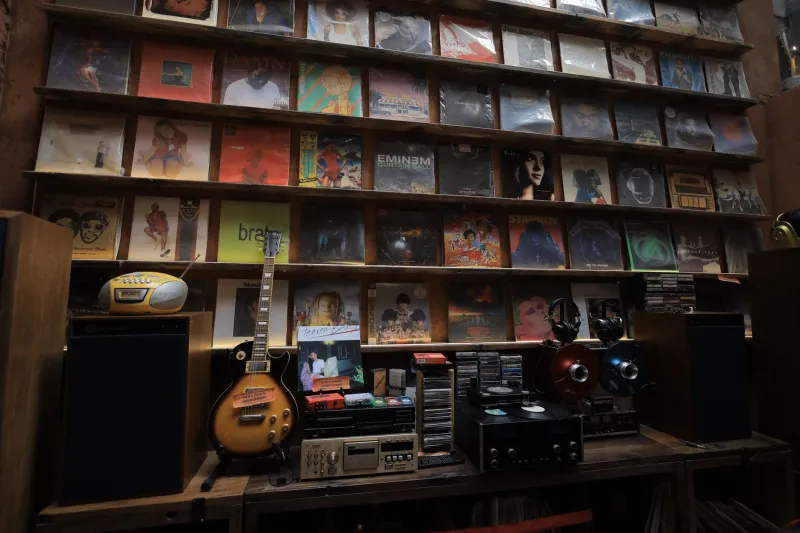
Walk into almost any serious collector's place and you'll notice something within the first few minutes. The shelves aren't just storage. They're a kind of autobiography — a physical record (pun very much intended) of who this person has been, where they've traveled, what they've loved, and occasionally, what they've regretted. Every gap between records has a story. Every beat-up sleeve has a provenance.
Now contrast that with what a lot of newer collectors end up with: a perfectly curated stack of albums that Spotify told them to like, every pressing sourced from the same three websites, every choice validated by a subreddit upvote. Nothing wrong with any of those records individually. But together? They tell the story of an algorithm, not a person.
That's the difference between accumulation and curation. And it's worth thinking about.
The Algorithm Has No Memory
Streaming platforms are genuinely incredible at surface-level discovery. They can find you something you'll probably enjoy in about thirty seconds flat. But they're working from a snapshot — your recent listens, your demographic, the collective behavior of people who sound like you on paper. They don't know about the summer you spent driving through New Mexico with nothing but a burned CD of Townes Van Zandt. They don't know your dad played Stevie Wonder's Songs in the Key of Life every Sunday morning until it became part of your actual DNA.
Vinyl collecting, at its best, is where that kind of memory lives. The physical object becomes a container for something the algorithm can never access: your actual life.
Marcus Webb, a collector based in Portland, Oregon who's been building his library for close to twenty years, puts it simply. "I can look at any record on my shelf and tell you exactly where I was when I bought it or why I needed it at that specific moment. That copy of Curtis Mayfield's There's No Place Like America Today — I found that at a church sale in rural Georgia on a road trip in 2009. It cost me a dollar. It's probably the most important record I own."
That dollar record means more than a hundred pristine reissues purchased on impulse because they showed up in a Best Of list.
Intentional Doesn't Mean Rigid
Here's where some collectors get it twisted. Building a meaningful collection doesn't mean you need a manifesto, a spreadsheet, or a strict genre focus. Intentionality isn't the same as rigidity. It just means you're paying attention — to your own reactions, your own history, your own curiosity.
Denise Okafor, who runs a small record exchange out of her home in Atlanta, describes her collection as "emotionally organized." Not by genre, not alphabetically. By feeling.
"I have a section I think of as 'Sunday morning records' — stuff that feels like light coming through curtains. I have a section that's basically 'when everything falls apart.' And I have a section that's pure joy, nothing else. When I'm buying, I'm always asking myself: where does this live in that map? If it doesn't live anywhere, I probably don't need it."
That kind of internal framework — whatever shape it takes for you — is what separates a collection from a pile.
Breaking the Crate Digger Trap
There's a different version of this problem that hits more experienced collectors. Call it the crate digger trap. You get so focused on rarity, condition, and pressing details that you lose track of whether you actually love the music. You've got a Northern Soul 45 in mint condition that you've never once played because it feels too precious. You've got a Japanese pressing of something you don't even particularly like, but it was a deal.
This isn't a knock on serious collecting — the technical side of this hobby is genuinely fascinating, and caring about quality is worthwhile. But it can become its own kind of autopilot. You're chasing the object instead of the experience.
Jamie Tran, a DJ and collector in Chicago, had to actively recalibrate after about a decade of serious digging. "I realized I had something like eight hundred records and I was only really connected to maybe a hundred of them. The rest were trophies. I started doing what I call 'the play test' — if I haven't played it in two years and I can't tell you why I love it, it goes. I've sold or traded off probably four hundred records since then. What's left actually means something to me."
Rediscovering the Impulse Buy (Done Right)
None of this means you should overthink every purchase. Some of the best records in any collection came from a gut reaction in a bin — something about the cover, the label, the feel of the sleeve. That instinct is worth trusting. The difference is that you're bringing yourself to the impulse, not a playlist.
Spend time in actual record shops. The physical act of flipping through bins, with no search bar and no algorithm, forces you into a different mode of discovery. You're encountering music on its own terms. You might stumble into a genre you've never explored because the cover of some obscure Brazilian funk LP from 1974 just looked right. That's how collections develop texture and surprise.
Supporting local shops matters here too — not just as a cultural statement, but as a practical tool. A good record store employee who knows your taste can put something in your hands that no recommendation engine would ever surface. That kind of human curation is irreplaceable.
What Your Shelves Say About You
At some point, step back and actually look at what you've got. Not to judge it, but to read it. What periods of your life are represented? What's conspicuously missing? Are there genres you've been meaning to explore for years but never pulled the trigger on? Are there records you bought for social reasons — to seem knowledgeable, to fit into a certain collector community — that don't actually connect with you?
A collection that tells your story will have weird gaps and unexpected combinations. It'll have guilty pleasures sitting next to critical darlings. It'll have records in rough shape that you'd never sell because of what they mean, and pristine copies of things you just genuinely love to listen to.
It won't look like anyone else's collection. That's the whole point.
The drift — the wandering, the unexpected turns, the gradual accumulation of a genuine aesthetic — is what this is all about. Not the destination, but the particular path you took to get there. Your shelves should be able to tell that story to anyone who knows how to read them.
Start there. The rest takes care of itself.