Why That Old Slab of Wax Sounds Better Than Your Brand-New Reissue
You've probably heard it at some point — someone at a record fair, or maybe a guy at the listening station in your local shop, muttering that the 1973 original just sounds different. Better, even. And you maybe nodded politely while quietly wondering if that was just audiophile mythology doing its thing.
It's not mythology. There's real, traceable science behind why an original pressing of a classic album can outperform a modern reissue, even one cut from a so-called high-resolution digital source. And the good news is you don't need a $10,000 turntable setup to hear the difference — or even to start identifying what era your record comes from.
Let's break it down.
It All Starts With the Tape
The single biggest variable in how a vinyl record sounds is what was used as the source during mastering. For original pressings, that typically meant the analog master tape — the actual multi-track or mixed-down reel that the band and engineers signed off on in the studio. That tape captured everything: the room sound, the warmth of the console, the full dynamic range of the performance.
Over time, that tape degrades. Oxide sheds. Splices dry out. Some tapes develop what's called "sticky shed syndrome," where the binder holding the magnetic particles literally becomes gummy. Labels that wanted to protect their originals made safety copies — called dubs or clones — but every generation of analog copying introduces a small amount of noise and signal loss.
By the time a label decides to reissue something in 2024, they may be working from a third- or fourth-generation copy, or from a digital transfer made decades ago at whatever resolution was standard then. Even a 24-bit/96kHz digital transfer, as good as it is, compresses some of the information that lived on that original tape. The reissue can sound perfectly fine — clean, even — but it's not the same signal.
The Cutting Engineer's Fingerprint
Once you have your source, someone has to cut it to lacquer. This is where mastering engineers leave their mark, and in the golden era of vinyl — roughly the late 1960s through the mid-1980s — some of those engineers became legends.
Names like Bernie Grundman, Bob Ludwig, and Doug Sax are well-known in audiophile circles, but the real cult figures are the ones you find stamped into the dead wax of the record itself. That hand-etched code in the run-out groove? It often identifies who cut the lacquer, and collectors use those codes like a fingerprint. A Porky Prime Cut on a UK pressing, or a "RL" hand-etched by Bob Ludwig on an Atlantic Records original, can add real value — and real sonics — to a record.
These engineers understood how to push the limits of what vinyl could do. They made decisions about equalization, stereo width, and low-frequency management that were tailored to the medium itself. Modern mastering, often optimized for streaming or digital playback first, doesn't always translate those same priorities to wax.
Pressing Plants Matter More Than You Think
Not all vinyl is created equal, and where a record was physically pressed makes a measurable difference. During the peak years of the format, plants like Monarch in California, Columbia's Pitman facility in New Jersey, and Hauppauge in New York each had their own reputation for quality. Overseas, plants like Pallas in Germany and Optimal became gold standards.
The vinyl compound itself varied too. Early records were pressed with a higher-grade PVC formulation before cost-cutting in the late 1970s led to "recycled" or "reground" vinyl — essentially a mix of scrap material that introduced more surface noise and reduced channel separation. If you've ever picked up a budget reissue and noticed it looks a little gray or translucent rather than pure black, that's often a sign of lower-grade compound.
Today's better reissue labels — think Analogue Productions, Mobile Fidelity (when they're working with original tapes), or Music on Vinyl — use 180-gram or 200-gram virgin vinyl pressed at quality plants. That part of the equation has genuinely improved. But the source material question remains.
How to Tell What You've Got
Okay, so how do you actually figure out what era of pressing you're holding? A few practical methods:
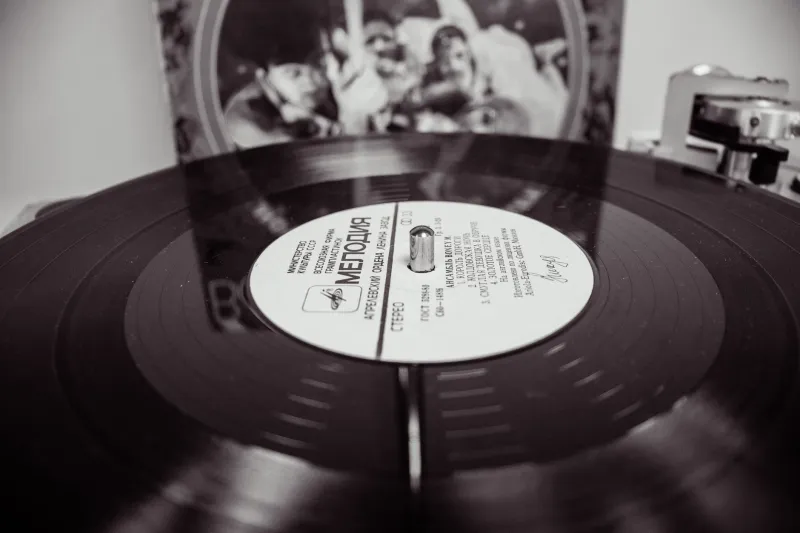
Check the dead wax. Flip the record over and look at the area between the last groove and the label. You'll typically see a catalog number, a side designation, and often a handwritten or stamped code. Look that code up on Discogs — it's one of the most useful databases for identifying pressings, and collectors have cataloged thousands of variations.
Look at the label design. Labels changed their artwork, fonts, and color schemes over time. A Capitol Records pressing with a rainbow label and a "Subsidiary of EMI" designation tells you something very different than one with the classic dome logo. Label variations are often the quickest visual shorthand for dating a pressing.
Check the matrix number pattern. Original pressings typically show a matrix number followed by a single digit (like -1 or A1). Later pressings often show higher numbers (-2, -3, etc.), indicating subsequent lacquer cuts. Lower numbers generally mean closer to the original source.
Feel the weight and look at the color. This isn't foolproof, but original pressings from the 1970s tend to be heavier and a deeper, more uniform black. Lighter, slightly translucent records often came from the cost-cutting era of the late '70s and early '80s.
Trust your ears. Put both versions on the turntable if you can. Listen for how cymbals decay, how the bass sits in the mix, how much space exists between instruments. Original pressings often have a quality that collectors describe as "air" — a sense of dimension that later copies can flatten out.
The Reissue Isn't Always the Enemy
It's worth saying clearly: not every reissue is a disappointment. Some modern reissue projects have been done with extraordinary care — sourced from the best surviving tape, cut by respected engineers, pressed at top-tier plants. And for albums where the original pressing was done carelessly or cheaply to begin with, a thoughtful reissue can actually be the superior listen.
The key is doing your homework. Check Discogs, read collector forums, look for reviews from people who've done direct comparisons. The vinyl community has done an enormous amount of this legwork already, and most of it is freely available.
At The Drift, we're firm believers that the hunt is half the point. Knowing what you're looking for — and why — makes the moment you find that original pressing in a dollar bin feel like actual treasure. Because it kind of is.